Interviews
Photography as Community: The Power of Collective Practice
Photography is usually described as a solitary pursuit: one photographer, one camera, one point of view. The description is accurate about the moment of expo...
Photography is usually described as a solitary pursuit: one photographer, one camera, one point of view. The description is accurate about the moment of exposure and wrong about everything else. Almost every photographic movement that mattered was collective, and almost every working photographer's opportunities arrived through other people.
Community is not a nice-to-have for creative work. It is the mechanism that makes individual progress possible, and it can be built deliberately.

Photo: Barkue Tubman Zawolo, Chief Community Officer, Sundial Media and Technology Group (2).jpg.jpg) by LaShawnda Jones — CC BY-SA 4.0, via Wikimedia Commons.
Learning Together
The photographers who improve fastest are rarely the ones working alone. They are the ones who show work, take feedback, study their peers, and participate in what researchers call a community of practice: a group organised around doing the same thing, where the standards are visible and criticism is normal.
What community provides is specific. It supplies the one thing solitary practice cannot, which is other people who can see what you cannot see in your own images. A photographer looking at their own archive is inside their own intentions, and that is a blind spot no amount of self-critique solves. Somebody who has never heard your explanation can tell you, in ten seconds, what your pictures actually say.
It also accelerates through comparison. Seeing good work regularly raises your internal standard without any explicit instruction, which is why proximity to better photographers matters more than workshops with famous ones.
Opening Doors
The photography industry runs on relationships, and it runs on them more than most creative industries, because hiring a photographer is a risk. Nobody can verify that a photographer will deliver on an unfamiliar brief, so they rely on having seen them work, on recommendation, or on having met them.
The people who commission, publish, exhibit and recommend photographers are overwhelmingly people the photographer has already met. That is not a conspiracy; it is how risk gets managed. The practical consequence is that cold emails and social media messages convert poorly, while being present and being useful in a community converts well, and slowly.
This is why the relationship work looks inefficient and is not. Three years of showing up at portfolio reviews, assisting, and helping other photographers leads to more paid work than a hundred outreach emails, because it produces something the emails cannot: a person willing to vouch for you.
Finding Your People
Community does not have to mean the whole industry. A functioning community can be six people whose work you respect and who will tell you when an image is not good enough.
Several forms are worth understanding, because they do different jobs:
- Local meetups and shooting groups. Good for regular practice, technical exchange and the discipline of making work to a schedule.
- Small critique groups. Three to eight photographers who meet monthly and review a specific body of work. This is the highest-value form of community for improving your work.
- Collectives. Groups that exhibit, publish or share a studio, giving members access to opportunities none of them could reach alone.
- Workshops and portfolio reviews. Time-limited, concentrated feedback from people who hire. Their value is the review, not the teaching.
- Online communities. Useful for scale and for finding people who share a niche, weaker for feedback because the incentives reward encouragement over honesty.
Find the smallest version that works. A critique group of five people you trust outperforms a forum of ten thousand.

Photo: Coffee Cup on Modern Table.jpg by Genaro35 — CC0, via Wikimedia Commons.
How to Run a Critique That Is Actually Useful
Most critique sessions fail because they are unstructured and polite. A simple protocol fixes both problems.
Bring finished work, not working files. Submit a project, a portfolio set, or a series. Screenshots of unedited frames invite technical commentary and produce nothing.
State what you want feedback on. One question per session, such as whether the series reads as coherent, or whether the sequencing holds. Without a question, everyone defaults to liking or disliking images.
Silent viewing first, then discussion. Give everyone two minutes to look without speaking, then ask each person for the first thing they noticed. Reactions precede analysis and they are more honest.
Require specificity. "I love it" and "I do not get it" are both useless. "The third image reads as softer than the rest, which makes the sequence feel like it loses conviction" is useful.
Separate observation from prescription. Note what an image does, then decide separately what to do about it. Most critique collapses because a legitimate observation arrives attached to a wrong solution.
Return to the same work next time. Progress is measured against previous sessions, not against other people's opinions in the room.
Giving as Much as You Receive
Community is reciprocal, and the photographers who get the most from one are generally those who contribute the most: honest feedback, referrals, technical help, assisting on other people's shoots, recommending someone else for an opportunity that does not suit them.
This is not a transaction with a ledger. It is a reputation, built slowly, which is why people who join a community solely to extract work tend to stay on its edges. The useful mental model is that you are building a network of people who answer your messages, and it takes years for that network to become valuable.
When Community Goes Wrong
Not every group is good for you. Two failure modes are worth recognising early.
The first is a community that substitutes approval for criticism. If nobody's work is ever questioned, the group functions as a support network rather than a community of practice, which is fine if that is what you need and a waste of years if you are trying to improve.
The second is a group organised around status rather than work: who shot for whom, who is in which group chat, who has access. These spaces consume enormous time and produce very little, and they are usually identifiable within a month by how rarely anybody's actual photographs are discussed.
Both are easy to leave and hard to leave late. The test is whether the last three meetings made your work sharper. If not, change the room.
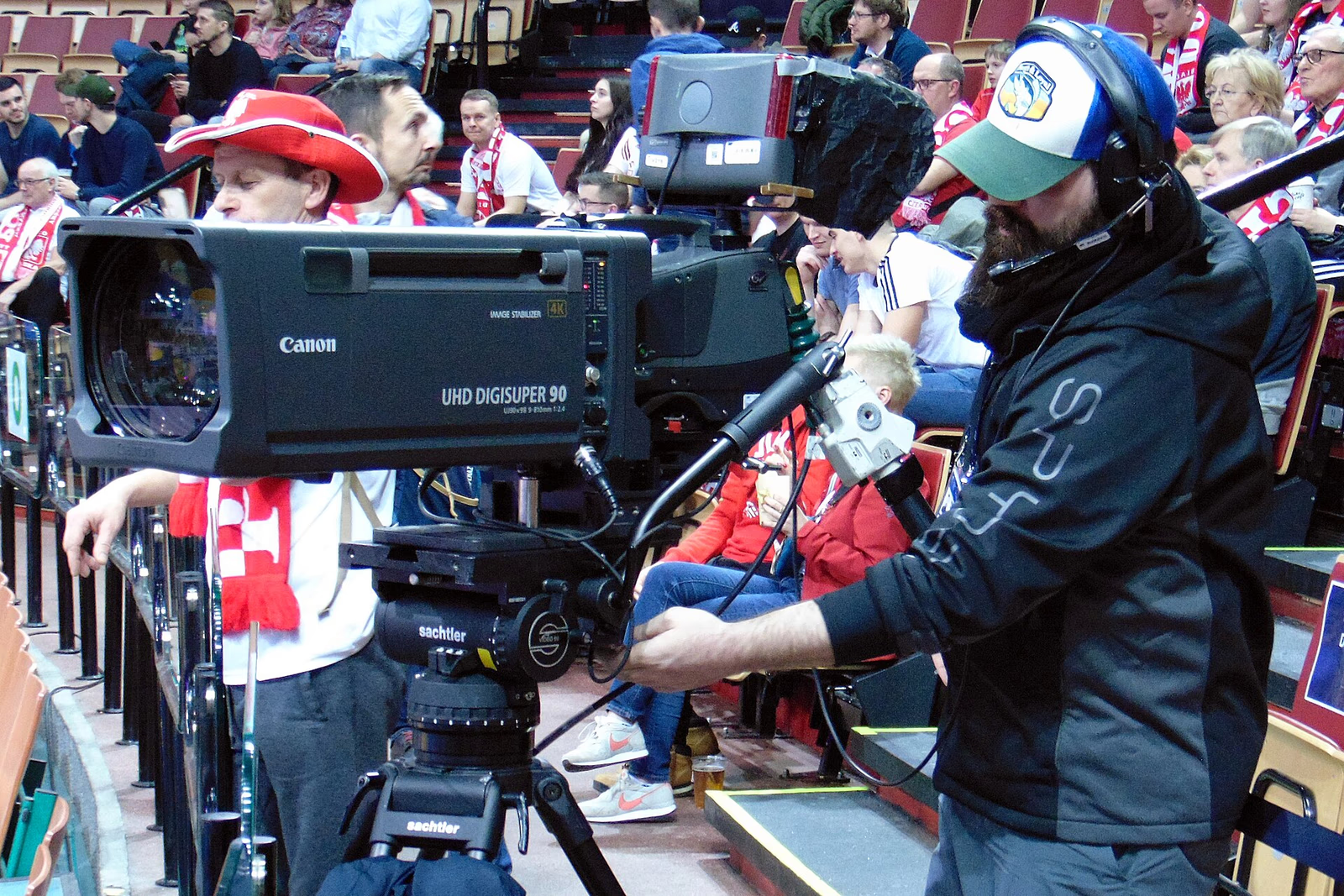
Photo: TV camera operator, Canon UHD DIGISUPER 90.jpg by Zalasem1 — CC BY-SA 4.0, via Wikimedia Commons.
Practical Tips
- Share your work regularly and ask for honest feedback, not reassurance.
- Find a small group of photographers whose work challenges you, and meet on a fixed schedule.
- Bring finished bodies of work to critique, not individual frames.
- State one specific question per session so feedback has a target.
- Insist on specificity. General praise and general disapproval both waste time.
- Attend workshops, portfolio reviews and events for the reviews rather than the teaching.
- Build genuine relationships over years rather than collecting contacts.
- Give more than you take: refer, recommend, assist, explain.
- Leave communities that never question anyone's work, and those that only discuss status.
Further Reading
Conclusion
Photography is collaborative in everything except the moment of pressing the shutter. Learning, opportunity and the standard you work to are all set socially, and photographers who try to skip that part improve slowly and then plateau.
The practical version is unglamorous. Find five people who will look at your work properly, meet monthly, ask a real question, and be useful to them in return. Do that for two years and your work, your honest self-assessment and your access to paid opportunities will all be different, and none of it will have come from an email.
FAQ
How do I find a photography community?
Start locally with photography meetups, gallery events or shared studio spaces, and look for a small critique group rather than a large forum. Online communities work for finding people with the same niche interests, but they are weaker for feedback because encouragement is rewarded more than accuracy.
Why does community matter for photographers?
It supplies what solitary practice cannot: people who see what you cannot see in your own work, opportunities that arrive through relationships rather than applications, and the standard that comes from being regularly exposed to better photography.
How can I contribute to my photography community?
Give honest, specific feedback, recommend photographers you respect, assist on other people's shoots, share technical knowledge, and pass on opportunities that do not suit you. Long-term benefit in a community follows contribution rather than networking.
What makes a good critique session?
Finished work rather than working files, one clear question per session, silent viewing before discussion, and a requirement that comments be specific. Separating what an image does from what to do about it prevents the argument that usually derails critique.
Do I need to be in a collective to benefit?
No. A group of five photographers who meet monthly and show real work produces most of the benefit. Collectives add access to exhibitions, publications and shared expenses, which matters more once your work is developed.
How do I know if a community is bad for me?
Two signals. If nobody's work is ever questioned, it is a support group rather than a community of practice. If the conversation is mainly about status and access rather than photographs, it will consume time without improving anything.