Interviews
The Future of Fashion Photography: Where the Industry Is Heading
Fashion photography is in one of its periodic reconstructions, and the forces driving it are not subtle: social media as the primary channel, artificial inte...
Fashion photography is in one of its periodic reconstructions, and the forces driving it are not subtle: social media as the primary channel, artificial intelligence as both tool and threat, a permanent shift in expectations about who gets photographed and how, and the collapse of the traditional magazine economics that paid for expensive shoots for most of the last century.
Understanding where the work is going matters less for prediction than for planning. A photographer who misreads this decade will build a portfolio and a skill set for a market that no longer exists.
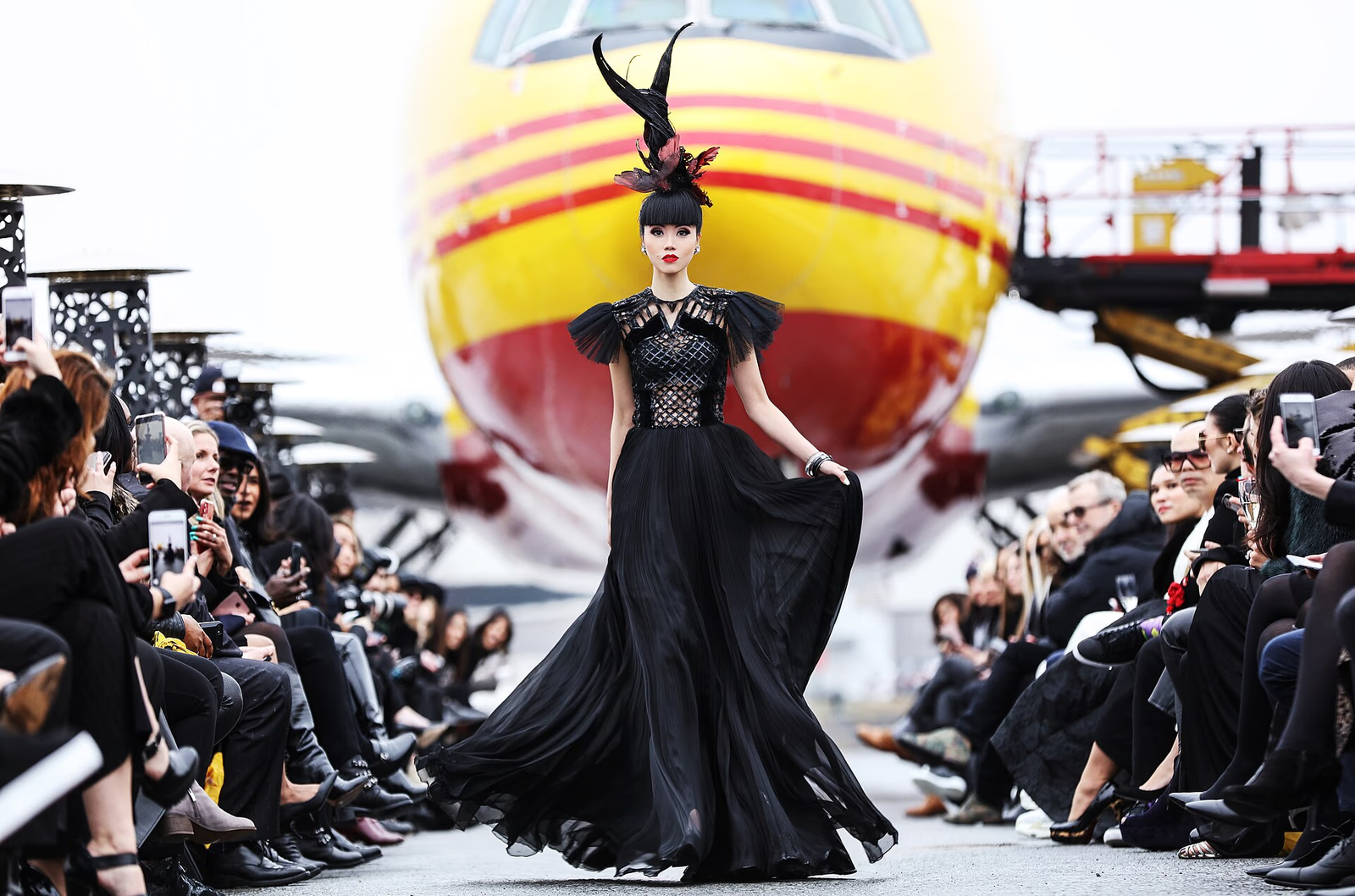
Photo: Jessica Minh Anh at Runway on the Runway Fashion and Sustainability Show 2020.jpg by John Oakley — CC BY-SA 4.0, via Wikimedia Commons.
Authenticity Over Perfection
The heavily retouched, uniformly perfect fashion image is losing its authority. Audiences, particularly younger ones, increasingly read heavy retouching as a claim they do not believe, and the industry has quietly adjusted in response: fewer plastic-looking skins, less impossible lighting, more visible texture and real environments.
The aesthetic effect is that fashion photography now borrows more from documentary than from advertising. Grain, available light, a face that looks like a face, and a location that is recognisably somewhere rather than nowhere. That is good news for photographers whose natural instinct is observation rather than construction, and less good news for anyone whose entire technique is smoothing.
The commercial logic behind it is worth stating plainly, because it predicts behaviour. When an image is obviously synthetic, viewers discount everything attached to it, including the product. Perfection now carries a credibility cost that it did not carry in 1995.
The Rise of the Multi-Platform Photographer
Photographers who work steadily over the next decade will be fluent across formats rather than specialised in one. Still photography remains the core, but the same shoot now typically produces motion, vertical social edits, and increasingly some element of live or experiential content.
That does not mean every photographer needs to become a cinematographer. It means the default deliverable has changed. A client commissioning a campaign expects a still set, a short-form video set, and cut-downs for social, and a photographer who can direct all three coherently is worth considerably more than one who hands over stills and leaves the rest to someone else.
The practical response is to learn the adjacent skills that multiply a still photographer's value: how to direct a subject in motion, how to light for both stills and video without relighting the room, how to edit a sequence, and how to shoot vertical frames deliberately rather than cropping them afterwards.
Diversity as a Restructuring, Not a Trend
The demand for representation, in front of and behind the camera, is a permanent change rather than a passing preference. Casting that ignored whole populations is now a commercial liability, and the photographers who benefit are those who have been photographing a wider range of people all along.
Two consequences follow. The first is that portfolios featuring one narrow beauty standard are now a weaker asset than the same portfolio covering a range. The second is that the range has to be real rather than performative: a photographer who only knows how to light one kind of face or one kind of body will find themselves unable to deliver when casting changes, which is a technical problem before it is an ethical one.
The specific skills that transfer poorly are worth naming. Lighting a dark-skinned face with an approach designed for pale skin, retouching a range of skin tones without destroying texture, and styling or directing bodies of different sizes all require learning rather than good intentions.

Photo: At our house.jpg by Chiroma photography — CC0, via Wikimedia Commons.
What AI Actually Changes
AI is reshaping two different parts of the industry, and the temptation to treat them as one problem is why the argument stays confused.
On the production side, AI has become a legitimate tool. Retouching, masking, upscaling, background extension, variation generation and editing automation are all faster than their manual equivalents, and photographers who refuse to use them are simply slower than their competitors. This is the same integration that happened with digital capture and with Camera Raw, and the outcome will be the same.
On the creation side, the tension is real, and it is a question of value rather than capability. Generated imagery that imitates a fashion photograph raises obvious questions about provenance and consent, and the audience response has been informative: campaigns that appeared to substitute synthetic imagery for human photography have been read as cost-cutting rather than innovation. The commercial lesson is that authenticity is now the scarce product, and human-made images command a premium precisely because the alternative exists.
The photographer's defensible position is not to compete with generated images on their own terms. It is to offer what generation cannot: a real person in a real place, at a real moment, with a relationship between the subject and the camera that a prompt cannot reproduce.
Where the Money Has Moved
The old model, in which a photographer was paid well by a magazine that recouped the cost through advertising, has largely gone. Its replacements are messier and more numerous.
- Brand-direct content. Brands now commission photographers directly for campaigns and social output, often with smaller budgets but faster timelines and less bureaucracy.
- E-commerce and catalogue work. High-volume, technically demanding and relatively stable. Less glamorous, and for many photographers the backbone of their income.
- Motion and social. Short-form video and vertical content, usually bundled with still commissions rather than bought separately.
- Experiential and event. Launches, installations and live documentation, where the photographer is part of the production rather than a supplier to it.
- Licensing and archive. Images with a long tail earn more over time than the fee that created them, which is an argument for keeping rights wherever the fee allows it.
Two career implications follow. Photography as a career is more assembled than it used to be, made of several income streams rather than one publication. And rights matter more when fees are smaller: a photograph licensed well for a decade can outperform a bigger one-off day rate.
Photo: DJ Tiesto party in 808 Nightclub, Bangkok, Thailand.jpg by Vyacheslav Argenberg — CC BY 4.0, via Wikimedia Commons.
What to Learn Now
For photographers planning the next five years rather than the next five months, the priorities are reasonably clear.
Learn to direct motion, because the same shoot now needs it. Learn lighting that survives being shot on video, since relighting between formats wastes the day. Learn to shoot vertical frames natively rather than cropping them from horizontal ones. Learn to work with a wider range of skin tones and body types competently rather than aspirationally. Learn to negotiate usage terms, because the fee is only half the value of a commission.
And keep the thing that cannot be automated: a recognisable point of view. In a market where technically competent images are abundant and generated ones are cheap, the only durable advantage is that your photographs look like nobody else's.
Practical Tips
- Prioritise authenticity and genuine human presence over manufactured perfection.
- Develop skills across formats: stills, motion, vertical social, and live production.
- Build a portfolio that reflects diverse representation rather than one narrow standard.
- Learn the technical side of photographing a wide range of skin tones and body types properly.
- Use AI tools for production, and compete on what generation cannot reproduce.
- Chase brand-direct, e-commerce and motion work rather than mourning editorial budgets.
- Negotiate usage and licensing, since smaller fees make rights more valuable.
- Stay curious about new technology without letting it define your work.
- Treat your point of view as the asset. Your gear is not one.
Further Reading
Conclusion
Fashion photography is not dying, but the version of it that dominated the last three decades is. The work is moving towards authenticity, multi-format delivery, genuine representation, and a market assembled from brand-direct, commerce and motion commissions rather than magazine pages.
None of that makes the craft less relevant. It makes judgement more relevant, because the technical floor has risen and the volume of competent images has exploded. The photographers who thrive will be the ones who can direct across formats, light for anyone, and make pictures that could not have been generated, because they were actually taken.
FAQ
Is fashion photography still a viable career?
Yes, but it is assembled differently. Photographers increasingly earn from brand-direct work, e-commerce, motion and social content alongside editorial, rather than from magazine commissions alone. Fluency across formats and a distinctive point of view matter more than they used to.
How is AI affecting fashion photography?
Two ways. As a production tool it makes editing and retouching substantially faster, and refusing to use it mainly makes you slower. As a generative tool it has raised the market value of authentic, human-made images, because audiences discount work they believe is synthetic.
What is replacing traditional magazine work?
Brand-direct content, e-commerce and catalogue photography, motion and short-form video, and experiential production around launches and events. Each has smaller budgets than the old editorial model, which makes licensing terms and repeat relationships more important.
Do I need to shoot video now?
If you want to work on campaigns, effectively yes. Most commissions now expect stills plus motion cut-downs from the same production, and a photographer who can direct both coherently is worth considerably more than one who delivers stills only.
Should I retouch less?
Retouch that flatters rather than erases. Audiences now read heavy smoothing as implausible, and the industry has moved towards visible texture and real environments. Removing identity to achieve a uniform standard is both an aesthetic and a commercial mistake.
What skills should a fashion photographer learn now?
Directing motion, lighting that works for stills and video without relighting, shooting vertical frames natively, photographing a wide range of skin tones competently, and negotiating usage rights. None of those are optional in the current market.
Will AI replace fashion photographers?
It will replace a portion of the work that never needed a photographer: catalogue variations, concept mock-ups, and low-value illustration. It will not replace the thing clients pay for at the top of the market, which is a real person, in a real place, photographed with a point of view.